Japan, the United States, and South Korea began joint military exercises on Wednesday to strengthen their cooperation amid tensions in the Asia-Pacific and the close ties between North Korea and Russia, which include sending soldiers to fight in Ukraine.
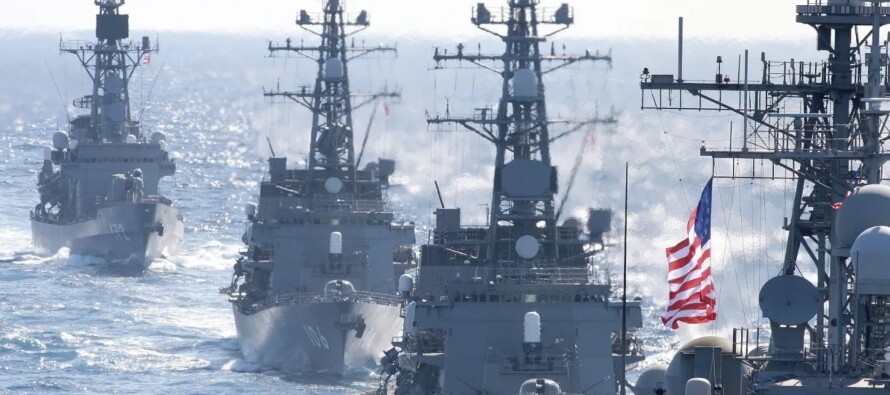
Japan's Self-Defense Forces joined the South Korean and U.S. armies in the East China Sea for the second round of the trilateral exercise 'Freedom Edge.' These maneuvers will last three days in international waters near the South Korean island of Jeju, following an agreement reached by the leaders of the three countries in 2023.
During this exercise, various warships and aircraft from the three participating countries will be deployed, including the U.S. aircraft carrier USS George Washington, the South Korean destroyer ROKS Seoae Ryu Seong-ryong, and the Japanese destroyer JS Haguro, which will conduct training against ballistic missiles, submarines, and fighter jets.
The goal of these maneuvers is to demonstrate the determination of Japan, the United States, and South Korea to promote interoperability and protect freedom to maintain peace and stability in the Indo-Pacific, including the Korean Peninsula, according to the Japanese Ministry of Defense.
In response to the first round of 'Freedom Edge' conducted just over four months ago, North Korea warned that "provocative acts" would have "fatal consequences." At the end of October, Pyongyang launched an intercontinental ballistic missile toward the Sea of Japan, which was the North Korean projectile that reached the highest altitude and flight time.
These maneuvers occur in a context where North Korean soldiers are fighting alongside Russia in the invasion of Ukraine, under a strategic partnership agreement between the two countries. A government official from Kyiv reported that around 50,000 Russian and North Korean soldiers deployed in the Russian region of Kursk are fighting against Ukrainian forces.
Additionally, China's rapprochement with Russia following the invasion of Ukraine has affected Beijing's relations with Tokyo. Chinese military activities near the Japanese archipelago, sometimes in collaboration with Moscow, are a constant concern for the Japanese government. In August, Beijing violated Japanese airspace for the first time, prompting a response from Japan's Self-Defense Air Forces with quick takeoff maneuvers.
South Korea and Japan are preparing for possible bilateral summits with Chinese President Xi Jinping as part of the Asia-Pacific Economic Cooperation Leaders' Week in Lima and the upcoming G20 summit in Brazil.
The joint maneuvers between Japan, the United States, and South Korea aim, in the words of the Japanese Ministry of Defense, to protect the peace and stability of the Indo-Pacific amid a tense geopolitical and military context in the region.