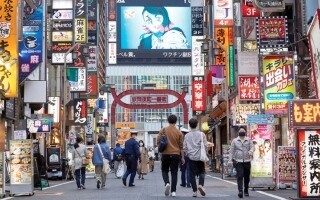
On a cold, windy winter afternoon, a young couple in sports shirts and hats stand before a list of apartments at a real estate agency near Takanoduka Station in northern Tokyo's Adachi ward. A woman in her mid-twenties, a hairdresser, says, "We are considering moving to this area because we heard it's a bit cheaper, but we also heard its reputation is not very good and it might be unsafe at night, so we are walking around to see the area for ourselves." She adds, "So far, it really looks like any other neighborhood." To outsiders, Adachi ward, particularly its commercial and entertainment districts like Takanoduka, has long been known as one of Tokyo's most dangerous areas, with its cheap bars, pachinko parlors, and decaying public housing complexes creating a sinister atmosphere. In reality, crime rates in the area have steadily declined for decades before ticking up slightly after the COVID-19 pandemic. Police data show that reports of theft, assault, and other crimes in Adachi have plummeted since peaking in the early 2000s. However, the perception of danger has faded more slowly. Following a recent renovation, Takanoduka Station has become the facade of a new commercial complex with upscale shops adding a touch of urban elegance. But just a short walk from the station, dilapidated buildings filled with Asian cafes and restaurants appear. Seiji Okushi, head of Adachi's design and planning division, said in 2021 the ward conducted a survey and found that "the sense of safety in Takanoduka is particularly low," with about 68% of participants rating the local level of safety as poor. This trend is more pronounced among people in their 20s and 40s and those who have lived in the area for a relatively short time. Okushi added, "Compared to the past, the number of crimes has decreased, and long-term residents tend to feel safer, but for newcomers, the sense of insecurity remains high." A gap has emerged between statistics and feelings, or what the Japanese police call the "general sense of safety," on a national level. Polls show that despite historically low crime rates, more people say they feel unsafe in their neighborhoods. This phenomenon is partly fueled by the declining population, the fraying of community ties, and the constant flow of misleading posts on social media and mainstream media coverage that amplifies certain crimes, creating a sense of danger that exceeds reality. In Takanoduka, the combination of old streets, active nightlife, and a large foreign population has perpetuated this image, even though workers and residents describe the area as quite cohesive and quiet. For two decades, crime rates in Japan appeared to be in a continuous decline. Crimes under the Penal Code, ranging from theft to violent offenses, peaked at around 2.85 million cases in 2002, then began a long decline driven by police reinforcement, new regulations, and widespread resident participation in crime prevention. By 2021, the national total had fallen to around 560,000 cases, marking the seventh consecutive year-on-year low since World War II. This trajectory has shifted slightly in recent years, with crime figures rising for three consecutive years. In 2024, the number increased by 4.9% from the previous year to around 737,000 cases, which still represents a fraction of the levels seen in the early 2000s. As residents returned to the streets after the COVID-19 pandemic and resumed daily activities, opportunities for crime increased. Japan's aging population has also complicated the picture, with seniors now more visible as offenders, especially in shoplifting cases, and as victims, particularly in fraud and cybercrime. In the 1970s, communications theorist George Gerbner coined the term "mean world syndrome" to describe how heavy exposure to violent or negative media can lead people to perceive the world as more dangerous, even when crime rates are stable or on the decline.