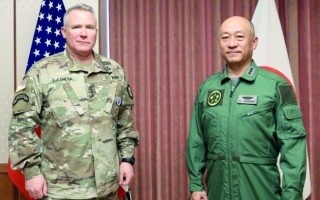
Recently, a new commander was appointed in Japan for the combined operations of the Self-Defense Forces. General Nagomu Kenishiro became the first commander of the new structure, uniting the Ground, Air, and Maritime Self-Defense Forces of Japan during a time of global and extraordinary situations. He is responsible for extraordinary situations in the territory near Taiwan.
The combined operations command begins its work on March 24 at the headquarters of the Ministry of Defense of the country in Tokyo. Its staff consists of about 240 people. This decision was made after the National Security Council approved the national defense strategy and the construction program of the Self-Defense Forces in December 2022.
Nagomu Kenishiro, a 59-year-old general, originally from the prefecture of Yamagata in northern Japan, served in the Defense Academy and began his service in the Air Self-Defense Forces in 1989. He has held various important positions, such as director of planning and defense policy in the Japan Air Self-Defense Force headquarters, commander of the Western Air Self-Defense Forces, and since March 2023 – deputy commander of the General Staff. This position is the second most significant after the commander of the Japan Air Self-Defense Forces.
It is worth noting that the Japanese government requested that the commander of American forces in Japan, a three-star general with headquarters in Yokota in western Tokyo, lead the forces, presenting reports to the commander of the Indo-Pacific command in Hawaii. Japan wants his rank to be raised to a four-star general, as is the case in South Korea.
As a result of the restructuring of the command structure of the Maritime Self-Defense Forces of Japan, focused on the lessons learned from the triple disaster that occurred on March 11, 2011, during the earthquake in Japan (earthquake, tsunami, and nuclear accident at Fukushima). This allowed for the removal of the then-general, Ohmura Ryuichi, who was overwhelmed with work and had to coordinate humanitarian operations, presenting reports to the Prime Minister and the Minister of Defense, as well as cooperating with the American Army. Since that time, it has been stated about the necessity of separating some of these responsibilities among other officials.
The restructured competence also involves cooperation with the American military due to the absence of a Japanese coordination system with American forces in the Indo-Pacific region.
The new commander will also work closely with American allies after, as it was announced in July 2024, the American forces in Japan will be re-prioritized as the Joint Forces headquarters and will present reports to the commander of the Indo-Pacific command in Hawaii.