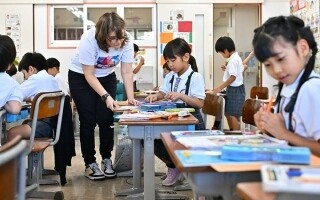
In a classroom filled with colorful hands-on activities and conversations in Japanese and English, students at the Okinawa International School in Nango city are busy using scissors, straw, plastic bottles, and balloons. Some use measuring cups for their experiments. Among 21 first-grade students engaged in creative activities, 66% are children whose families have moved from outside Okinawa Prefecture, most of them from the Tokyo metropolitan area. The Okinawa International School was founded in Naha city in 2003 as an international preschool and is now an accredited school offering the International Baccalaureate (IB) curriculum, spanning from kindergarten through high school. This year, students from other prefectures made up more than 60% of the total student body, surpassing the number of local students for the first time. Some of them transferred from IB-accredited schools in Tokyo. With two campuses—one in Naha for preschool and elementary levels, and another in Nango for elementary through high school—the Okinawa International School enrolls about 220 students aged 3 to 18 starting this September. The school's mission is to nurture global leaders capable of succeeding on the world stage. Amid the spread of remote work during the COVID-19 pandemic, an increasing number of families contacted the Okinawa International School about moving to the prefecture specifically for their children's education. The school's reputation grew significantly after its first high school graduate achieved the second-highest average score on the international IB exam in Japan in 2022, among approximately 70 accredited schools nationwide. In many cases, only the mother and child move to Okinawa, while the father remains in Tokyo for work. Some fathers with flexible work arrangements frequently commute between Tokyo and Okinawa, and several decided to relocate after spending long holiday periods in the prefecture. The head of the Okinawa International School, Sogo Okuma, said: "The international atmosphere and natural beauty of Okinawa are certainly appealing, but for many families, the decisive factor is the affordability." He added: "Despite inflation and the weakening yen, the cost of education and living in Okinawa can be covered for about the same cost as living in central Tokyo." The annual cost for elementary education at the Okinawa International School, including tuition and other fees, is about 1.5 million yen ($9,600), while for middle school it is about 1.8 million yen. Although the costs are higher than in public schools, they are still lower than most international schools in Tokyo. Amid growing interest in international education among Japanese families, Okinawa Prefecture has become an attractive option for those who want to send their children to international schools with less financial burden, according to Okuma. In response to increased demand since the pandemic, the Okinawa International School participated in an education fair in Tokyo in 2024 that brought together international and private schools from across the country, and also launched a housing support website in partnership with Okinawa real estate agents to help with "relocation for educational purposes." As a result, the school received 173 inquiries from outside Okinawa Prefecture that year, more than double the 77 inquiries from within the prefecture. The Okinawa International School reported that parents who moved to Okinawa have appreciated the relaxed atmosphere in the prefecture. The school quoted one father as saying: "Unlike in Tokyo, we don't feel that other parents judge us based on where we live or what we wear." Another father said: "We live here without pressure." To avoid legal uncertainty, many Japanese parents whose children attend international schools choose a dual enrollment system, where the child is registered in both an international school and a local public school at the same time. While approval for such an arrangement is at the discretion of the local education board, municipalities in Okinawa Prefecture approve it in principle.